WisHope launched in Sauk County this spring
Posted: June 18, 2021 5:18 PMUpdated: June 18, 2021 6:22 PM by Madalyn O’Neill
MADISON, Wis. – Addiction is a lonely road already. COVID-19 only drove friends and family farther away.
“The pandemic really was isolating for a lot of people,” said Sara Jesse, a community health strategist with the Sauk County Public Health Department.
The number of drug overdose deaths in the county rose from 13 in 2019 to 21 in 2020.
“We are so concerned about the spike of overdoses in our community during the pandemic,” Jesse said, adding that the numbers represent both accidental and purposeful overdoses. “I can tell you, Sauk County typically sees about 14 overdose deaths per year, which is already astronomically high given our population.”
“Isolation, loneliness, not being able to work and meet their needs, those are huge triggering factors for people to relapse and use,” said Ryan Ramnarace, a peer recovery coach.
A new opportunity to save lives
Baraboo Paramedic Niko Oehlenschlager never gets used to helping people through an overdose — certainly not when they don’t make it through.
“Patients’ families stick out the most,” Oehlenschlager said. “It’s a profound feeling of helplessness. It’s palpable.”
Usually, his work doesn’t go beyond the incident itself.
“Typically in my work, we don’t see the other end after we make contact with the patient,” Oehlenschlager said.
“It’s really frustrating because we don’t know the people being treated by EMS and being released out there into the night,” Ramnarace said.
As a peer recovery coach, Ramnarace leads people through the often-overwhelming recovery landscape, in part by connecting his own past experience.
“To be real honest, at one time, I used to be part of the problem in Sauk County,” he said, adding that he spent 14 years in prison for drug conspiracy. “It drove me, made me want to be part of the solution.”
Now part of that solution is WisHope, which pairs up coaches like Ramnarace with EMS responders like Oehlenschlager. The two have gone back to patients Oehlenschlager helped save in the days after an overdose. Referrals after such incidents can provide a unique opportunity for the team to reach people who need help.
“We haven’t really been offered an opportunity like this before,” Oehlenschlager said. “We can provide some sort of safety net.”
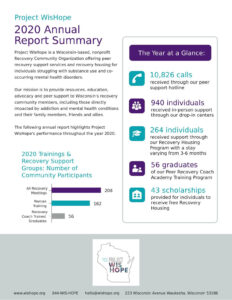
WisHope, which partners with agencies throughout the state, is led by Peter Brunzelle.
“It’s both heartbreaking and a blessing,” Brunzelle said. “It’s too often we lose people, especially now.”
COVID-19 has stopped people from connecting, interrupting in-person groups and therapy. He wants to strengthen that connection again.
“The more we can shift culture toward helping and reaching out instead of looking away, the more people are going to get connected,” Brunzelle said.
As part of the program, they have set up a hotline (844-WIS-HOPE) and a website found here with a map of available resources that helps cut through the many fake options Brunzelle said show up during a Google search.
Part of a recovery coach’s job is to bring lived experience with substance abuse, along with connecting people with resources.
“Part of my job is being a resource broker,” Ramnarace said. “I try to help and show people there is a life after use.”
While he can offer options, he can’t make people go down that road. But he can walk with them every step of the way.
“The heart of peer support is walking with them on their journey,” Ramnarace said.
“Drug users are not criminals. They’re you and I walking around on our streets, we would never suspect are struggling,” Jesse said. “It has been criminalized, but what they really need is treatment, support. It’s a medical connection once they are addicted.”
COPYRIGHT 2021 BY CHANNEL 3000. ALL RIGHTS RESERVED. THIS MATERIAL MAY NOT BE PUBLISHED, BROADCAST, REWRITTEN OR REDISTRIBUTED.
Recovery Milestones Worth Celebrating (That Aren’t Just Days Sober)
Feel Good Friday. Late October has a way of turning people reflective. This felt like the right week to talk…
Read More
5 Ways the WisHope Community Shows Up When Things Get Hard
Thrilling Thursday. Recovery gets sold as a solo project a lot of the time. One person, one decision, one day…
Read More
Let’s Talk About Grief in Recovery
Truth Tuesday. There’s a myth that floats around recovery spaces: death and grief are too heavy to bring up. Too…
Read More
The Wisdom of Boundaries in Recovery
Wisdom Wednesday. Boundaries get treated like a buzzword sometimes, tossed around without much weight behind them. Boundaries in recovery though,…
Read More
Plateaus are Normal: Momentum Doesn’t Always Feel Like Progress
Momentum Monday. Plateaus are normal in recovery. Some weeks feel like real movement. Other weeks feel like standing still, doing…
Read More
What’s Coming Up in October at Project WisHope
Feel Good Friday. Fall is here, and so is a full month of ways to connect. From football to pumpkin…
Read More
Identity Beyond Sobriety
Wisdom Wednesday. For a while, sobriety has to be the main thing. Early recovery often means organizing your whole life…
Read More
Heading into Fall, You Got This
Momentum Monday. Two seasons down in this year we call 2026. Spring asked you to keep going when things were…
Read More
September Wins at Project WisHope
Feel Good Friday. September is wrapping up, and it’s worth pausing to look back at everything this community showed up…
Read More
Winterizing Your Recovery Before the Hard Season Hits
Wisdom Wednesday. Happy fall! Yesterday was officially the first day of the new season. But before the first hard frost,…
Read More